Latest update: July 27, 2026 - 5 min read
IRS Mileage Rate 2026: 76 Cents Per Mile
The IRS set the 2026 standard mileage rate at 76 cents per mile for business driving, effective July 1, 2026. The mid-year increase from 72.5 cents, set in January 2026, was due to rising fuel prices, prompting the IRS to adjust the rate.
2026 standard mileage rates (business, medical, moving, charity)
| Purpose | 2026 rate (from July 1) | 2026 rate (January 1 - June 30) | 2025 rate |
|---|---|---|---|
| Business | 76 cents per mile | 72.5 cents per mile | 70 cents per mile |
| Medical / moving (Armed Forces) | 23.5 cents per mile | 20.5 cents per mile | 21 cents per mile |
| Charitable | 14 cents per mile | 14 cents per mile | 14 cents per mile |
The business rate is the one most people use. If you drive your personal vehicle for work — whether you’re self-employed or getting reimbursed by an employer — this is the rate that applies to your miles. Take a look below to see how the rate has changed over the years.
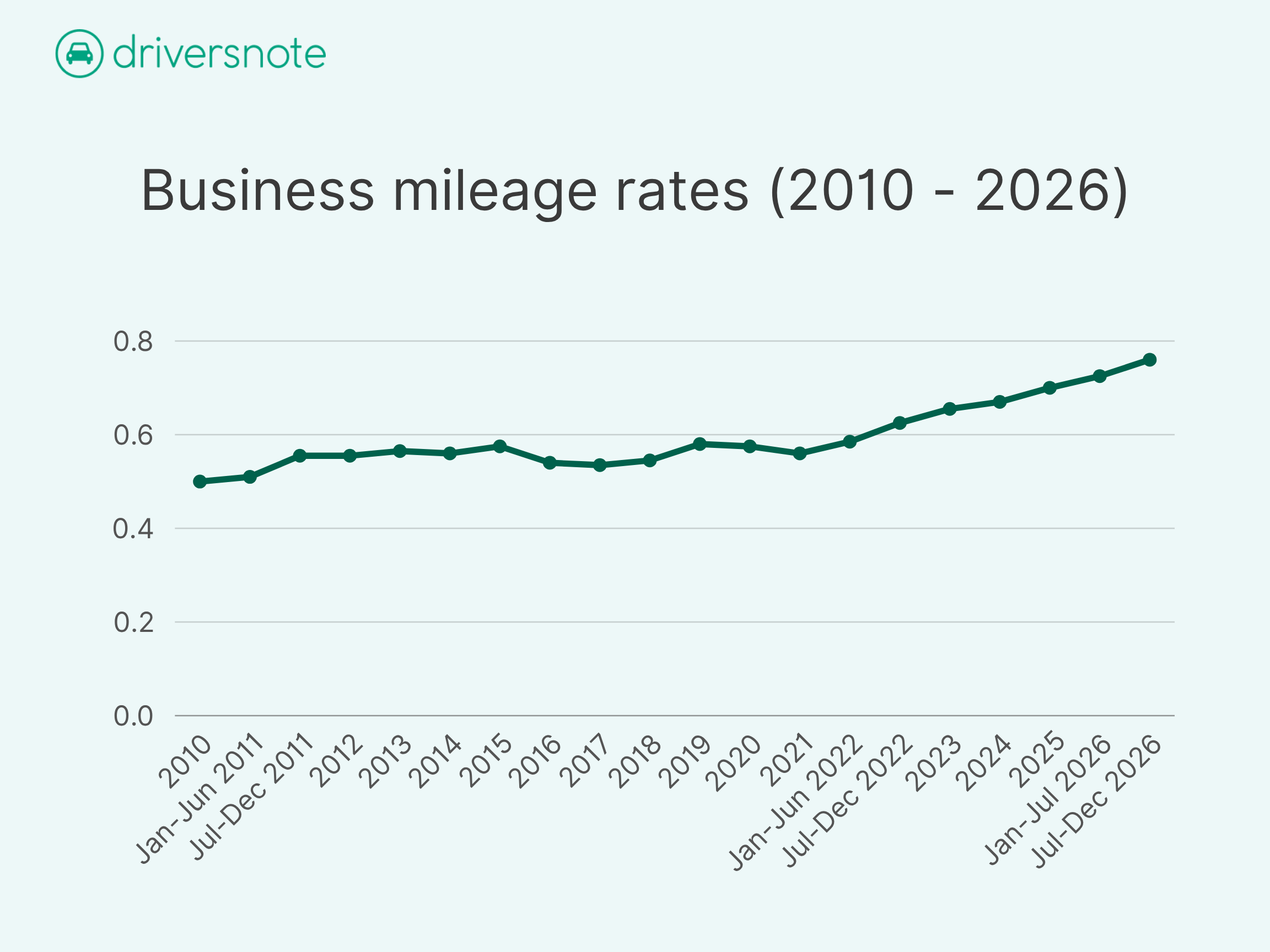
For further reading, see the IRS Bulletin, published July 13, 2026.
What does 76 cents per mile mean in practice?
The standard mileage rate is designed to cover all the costs of using your car for business: fuel, depreciation, maintenance, insurance, and registration. You don’t need to track individual expenses. You just multiply your business miles by the rate.
Here’s what that looks like at different mileage levels:
| Business miles driven | 2026 deduction/reimbursement (second half of the year) |
|---|---|
| 2,000 miles | $1,520 |
| 5,000 miles | $3,800 |
| 10,000 miles | $7,600 |
| 15,000 miles | $11,400 |
| 20,000 miles | $15,200 |
Self-employed drivers who use their car actively throughout the year claim around $5,500 on average. For anyone driving regularly for work, the deduction is substantial — and it compounds across the year trip by trip.
Use the mileage reimbursement calculator to work out your specific figure for 2026 or any recent year.
Why the rate went up
The IRS adjusts the standard mileage rate annually to reflect changes in the cost of operating a vehicle — primarily fuel prices, depreciation, and maintenance. The 2.5-cent increase from 2025 to 2026 followed several years of adjustments in response to shifting vehicle costs, while the unexpected mid-year shift from 72.5 to 76 cents was prompted by rising fuel costs.
Does the 2026 rate apply to your situation?
Self-employed (1099)
As a self-employed individual who drives for business, you can claim a tax deduction on your business vehicle expenses using the standard mileage rate set by the IRS, or apply the actual expenses method. The choice will largely depend on your vehicle and how much you drive in a tax year.
Our self-employed mileage guide is a good place to start, if you want the rules explained in detail.
Employees (W-2)
If you’re an employee driving a personal vehicle for work, your employer can choose to apply the standard mileage rate to reimburse you for all business-related driving.
They can, however, reimburse you at a rate lower than the one set by the IRS. Bear in mind that if you get reimbursed at a rate higher than the standard mileage rate, it’s considered taxable income.
Also read: Are Employee Reimbursements Taxable?
Note: According to the Tax Cuts and Jobs Act 2017, most W-2 employees can’t deduct unreimbursed expenses on their tax return. This law has recently been made permanent for most workers. Consult your individual case with your employer or accountant.
You can find out more about mileage reimbursement rules for employees in our guide.
Employers
You’re not required to reimburse at exactly the IRS rate. You can set any rate you choose. Reimbursements at or below 76 cents per mile are tax-free for employees. Above it, the excess becomes taxable income. Learn more in our IRS mileage guide for employers.
What Driversnote does with the rate
Driversnote automatically applies the current IRS rate to every business trip you log. As you drive, your running deduction or reimbursement total updates in real time — so at any point during the year, you know exactly what you’ve earned. No spreadsheet at year-end. No trying to remember which trips were business and which were personal.
If your employer reimburses at a different rate — say 65 cents or 80 cents per mile — you can set that custom rate instead. Driversnote calculates your reimbursement against your employer’s rate, not the IRS standard, and your reports reflect that automatically.
At tax time or when submitting for reimbursement, you generate a report in one tap. It includes every trip, the rate applied, and the total — in an IRS-compliant format your accountant or employer can use directly.
You need a mileage log to use the rate
Knowing the rate is step one. Actually claiming it requires a compliant mileage log — a record of every business trip with the date, destination, miles driven, and business purpose, kept at or near the time of the trip.
The IRS doesn’t accept estimates or reconstructed logs. If you’re audited, you need contemporaneous records. That’s the requirement whether you’re self-employed filing a deduction or an employee submitting for reimbursement.
If you want to start tracking properly, you can download a free IRS mileage log template in PDF, Excel, or Google Sheets. Or use Driversnote to track automatically — every trip can be logged in the background with all the required fields, ready to export whenever you need it.
2026 vs 2025 — does the old rate still apply?
Yes, for the right period. If you’re filing your 2025 taxes now, the applicable rate for miles driven in 2025 is 70 cents per mile. The 2026 rate (72.5 cents) applies only to miles driven from January 1, 2026 until June 30, 2026. From July 1, the new 76c rate applies.
If you drove in both years and are calculating your total deduction, apply each year’s rate to the miles driven in that year. See the full IRS historical mileage rates for a complete table going back to 2010.
How to calculate my reimbursement or tax deduction?
By multiplying the miles driven by the standard mileage rate, you can estimate your mileage reimbursement. For a quick calculation, use our free IRS mileage calculator.
Here’s an example:
Your logs show you’ve driven 170 miles for business from January until June 2026, and 80 miles since July. The 2026 standard mileage rate is 72.5 cents per mile, and 76 cents per mile from July 1.
To find your reimbursement, you multiply the number of miles by the rates:
[miles] * [rate], or 170 miles * $0.725 + 80 miles * $0.76 = $184.05
How are the mileage rates determined?
The IRS business mileage rate is reviewed annually and updated to reflect the current costs of owning and operating a vehicle in the U.S.
The business mileage rate factors in both fixed and variable vehicle expenses. In contrast, the mileage rates for medical and moving purposes are calculated using only variable costs.
Fixed costs include expenses such as:
- Insurance
- Registration and licensing fees
- Lease payments
- Vehicle depreciation
Variable costs cover expenses like:
- Fuel or charging costs
- Parking
- Oil
- Tire replacements
- General maintenance
The charitable mileage rate is set by law and has not changed since 1998.
The bottom line
The 2026 IRS standard mileage rate is 76 cents per mile from July 1. Every business mile you drove this year between January and June is worth 72.5 cents towards your deduction or reimbursement, and 76 cents per mile from July onwards — but only if you have the records to back it up.
For a full guide on deduction rules and eligibility, see self-employed mileage deductions.
FAQ
For the second half of 2026, the IRS mileage rate for business use is 76 cents per mile. The rate for medical or moving purposes is 23.5 cents per mile, while the charitable mileage rate remains 14 cents per mile.
Yes. The new IRS standard mileage rate for business use, effective July 1 2026, has increased to 76 cents per mile, up from 72.5 cents set in January 2026. The increase reflects higher vehicle-related costs such as fuel, maintenance, and insurance.
No. Employers are not legally required to reimburse employees at the IRS mileage rate. The rate serves as a tax guideline. If an employer reimburses above the IRS rate, the excess may be treated as taxable income.
There is no overall cap on how many miles you can deduct. However, only eligible miles driven for approved purposes can be claimed, and they must be properly documented.
For many self-employed individuals and business owners, claiming mileage can significantly reduce taxable income. Whether it’s worth it depends on how many miles you drive for eligible purposes and which deduction method you choose.

Tired of logging mileage by hand?
Effortless. IRS-compliant. Liberating.
 Auto-track trips
 Classify trips
 IRS compliant reports